Insights
·
1 MIN
1 jul 2022
Why Customer-Centered Innovation Isn't Enough: Lessons from Nintendo Wii
Entrepreneurs believe a customer-centered innovation approach is the only way to grow.
This is why I don't think it's enough.
In a highly competitive market, you need to search for alternative methods of creating value, and you cannot just see how your customers behave or what their main needs are.
I would like to share this framework developed by Roberto Verganti. It may help to foster untapped new initiatives and explore different ways of innovation in your company.
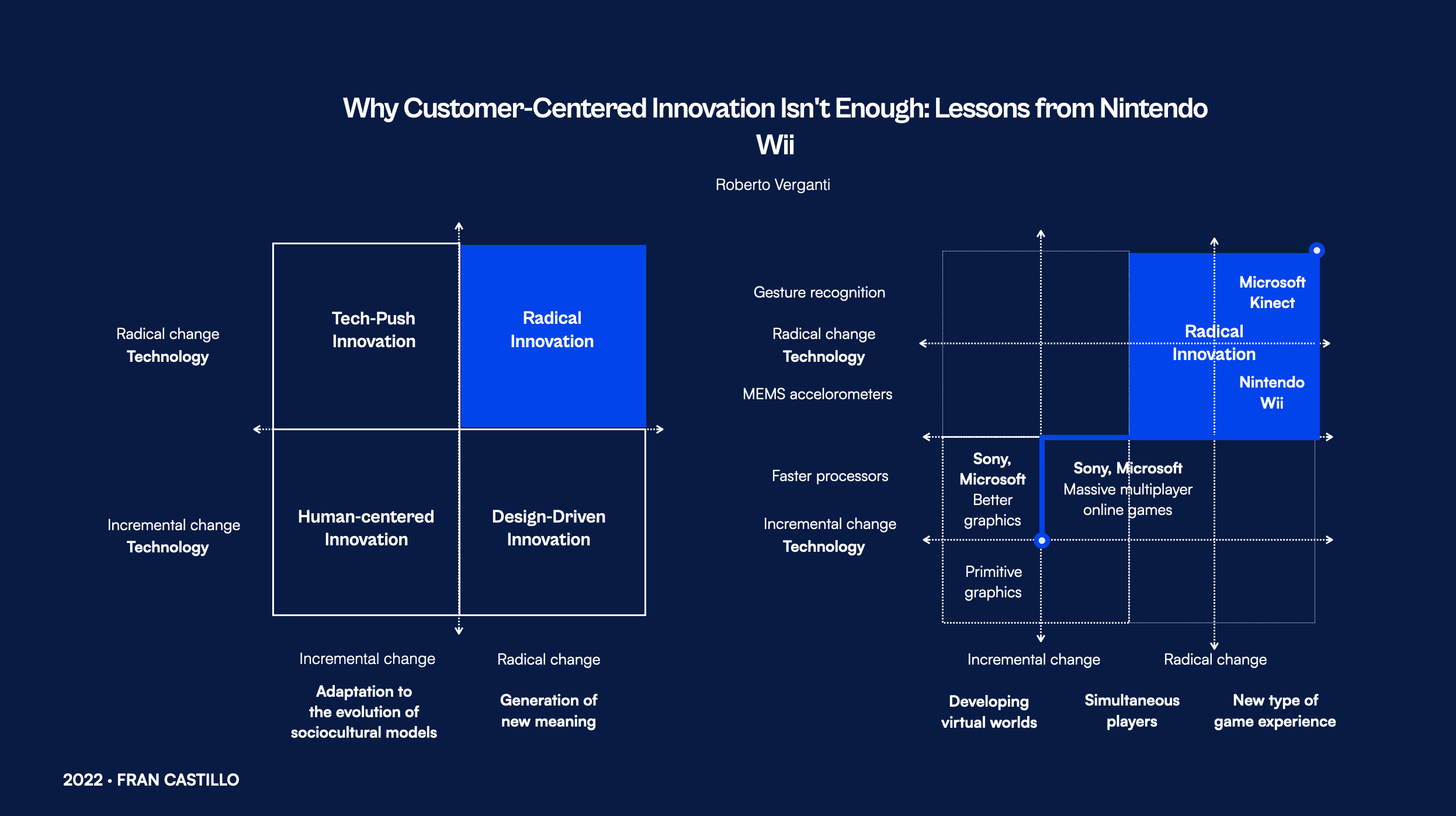
The framework is divided into two axes:
Technology-driven innovations are shifts in meaning that take place because of a new technology.
Meaning-driven innovation involves understanding shifts in societal & cultural dynamics, creating new meanings.
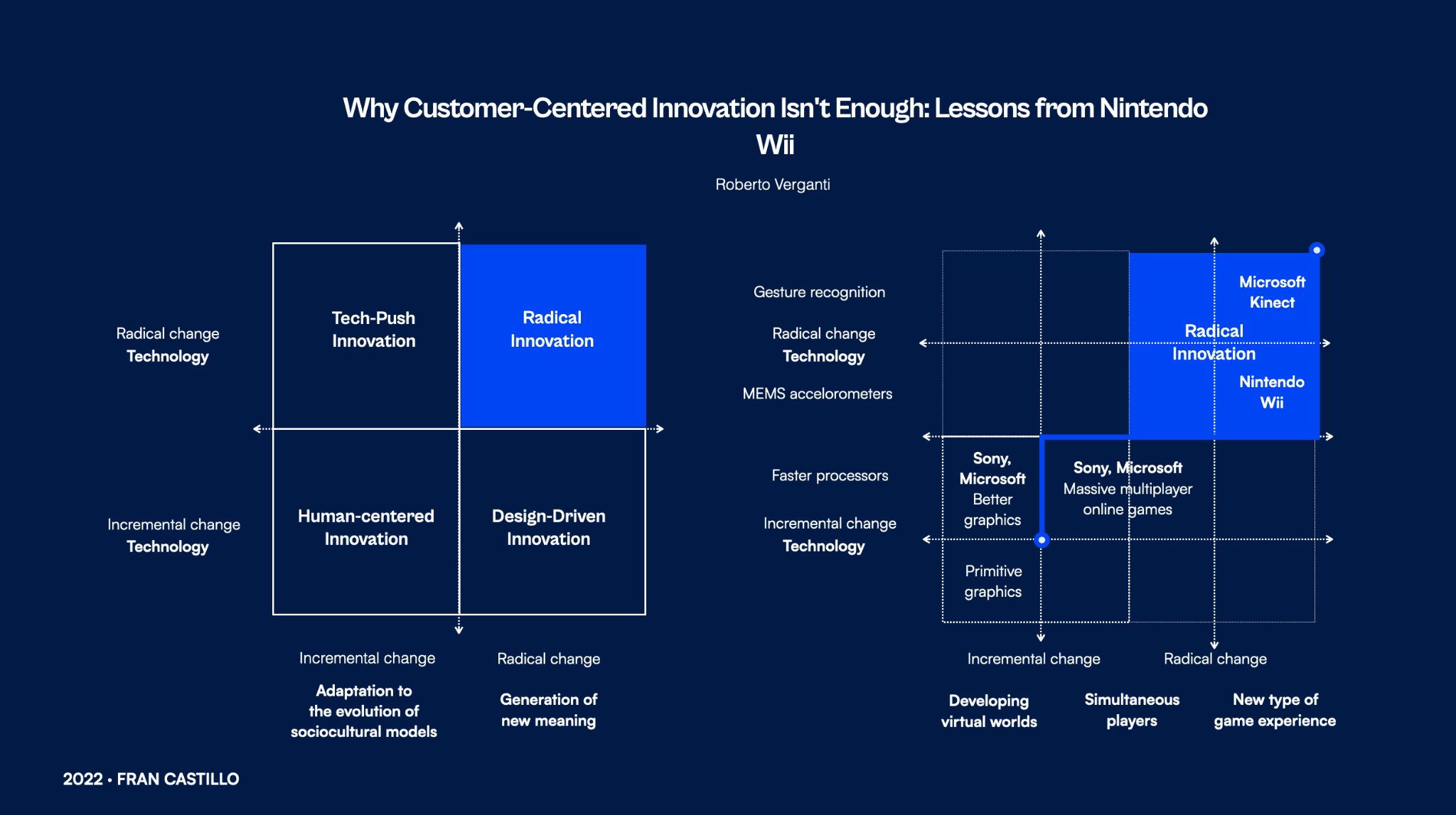
The framework provides four types of innovation :
Customer-centered innovation. Market-pull innovation involves Incremental innovation by analyzing the needs of the user.
Technology-push Innovation is due to radical change in tech.
Meaning-driven innovation. Changing the emotional, symbolic content of products through a deep understanding of broader changes in society & culture. Rather than being pulled by user requirements, design-driven innovation proposes new product meanings & languages.
Radical innovation is the process where a radical change in technology takes place as well as a radical change in meaning. Within this framework, you can find new value propositions to extend your product & business model.
Finally, A successful business case to better understand this framework - Nintendo Wii.
According to IDEO, Human-centered design is, “… a process that starts with the people you´re designing for and ends with new solutions that are tailor made to suit their needs.
Can Human-centered design help solve problems that are yet to be faced by a consumer?
Human-Centered Design succeeds when things are observable, knowable, tangible and measurable. For the times those criteria are not present we need an alternative to Human-Centered Design
In this particular scenario (Nintendo Wii), How will the next device to revolutionize gaming come into being?
It's difficult to seek user input as a way of imagining and creating new devices for the act of gaming.
Customers can tell you how they want existing devices to function better, but it is unlikely that they can imagine a whole new way of doing things.
In order to design radical innovations, an alternative framework to Human-Centered Design is required.
If Nintendo had closely observed teenagers using existing game consoles, it probably would have improved traditional game controllers, enabling users to better immerse themselves in a virtual world, rather than redefining what a game console is…
Wii Business case :
Customer-centered innovation. (Developing virtual words with faster processors)
Technology-push Innovation (Gesture recognition)
Meaning-driven innovation. (Massive multiplayer, online games)
Radical innovation (Gesture recognition, accelerometers and new types of game experiences).
Technology and Meaning change have shaped a new category in the games industry.


